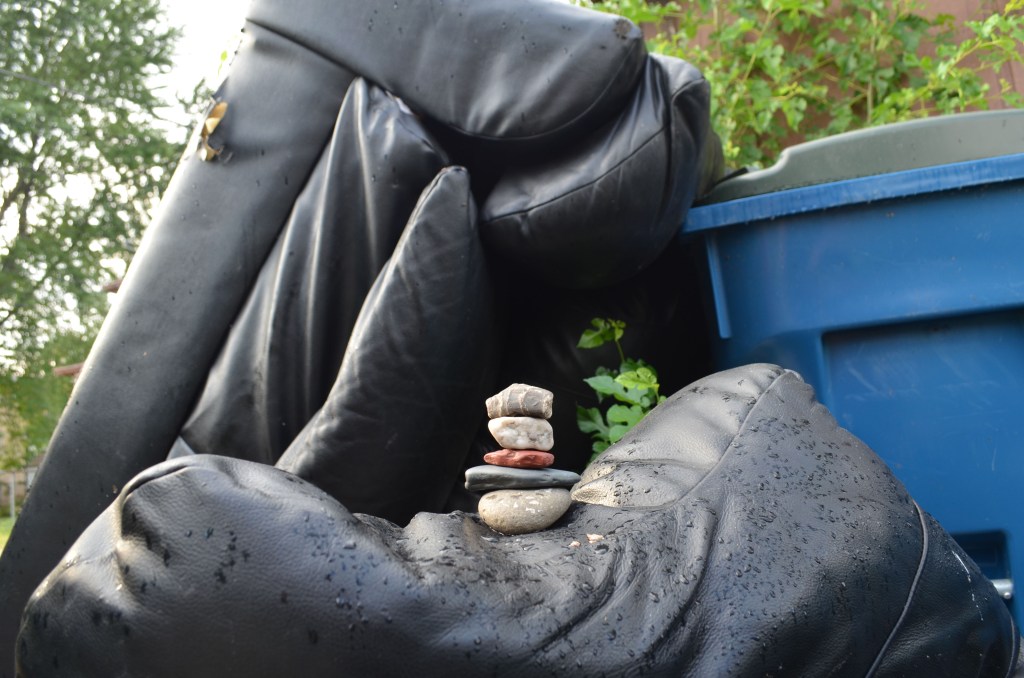
I’ve been seeing this sofa for several days in my regular drive down the alley toward my garage. It got me to wondering about all the sofas that get tossed and whether there were options to just dropping it into the local garbage mountain. One entry in my search engine “furniture in landfills” lead me directly to PLANETSAVE‘s website where writer Joanna writes in her 2011 entry that the EPA reports that in the United States we are putting annually 9.8 million tons of furniture into our landfills.
So I went to the EPA site, which offers a highly detailed report of our daily habits of garbage generation: on average, every individual in the US is generating a whopping 4.4 lbs of garbage per day! By contrast, our EU neighbors daily production of trash is 2.9 lbs. per day. A dubious distinction that is not in our favor. In its June 2015 report, the EPA stated that
“In 2013, Americans generated about 254 million tons (U.S. short tons unless specified) of trash and recycled and composted over 87 million tons of this material, equivalent to a 34.3 percent recycling rate (see Figure 1 and Figure 2). On average, Americans recycled and composted 1.51 pounds out of our individual waste generation rate of 4.40 pounds per person per day.”
I am trying to be the change I want to see in the world by putting into my recycle bins every possible recyclable material that I can. All my grass clippings become mulch for my gardens. All my food scraps go into my circular composter, getting turned daily and then, each season it gets turned back into the garden soil. I do not purchase water in bottles, as that’s the best way to cut down on that material’s re-entry into our system. I now go to re-sale shops to purchase necessary items, and when I need a book I am purchasing used books on Amazon and Half.com. I still think I need to do more.
What responsible practices are you following to recycle, reuse, and otherwise cut back on the amount of trash you are generating? Looking for ideas? Joanna’s previously credited entry above includes the following helpful ideas for dealing with furniture you no longer want or need:
Measure twice, buy once! Plan and organize your space ahead of time before purchasing furniture pieces in your home. When purchasing new furniture, always research the company’s environmental policies and their initiative in reducing waste. Check out IKEA’s CSR policy.
Try to look for multiple-function furniture pieces like convertible sofas and futons. Having a guest bed and a sofa built into one piece of furniture helps save on important materials such as wood and reduces deforestation.
Reuse
There is plenty of usable “pre-owned” furniture available through Craigslist, Freecycleor even a garage sale!
Use slipcovers to keep your existing furniture looking fresh and new to last you for years to come.
Renew your chair by removing the seat and fabric — check to see if the foam is still usable (no mold) — and replace the fabric with new (preferably organic) fabric with a staple gun.
Donate your good-condition furniture to those in need, such as the Salvation Army or Goodwill.
Recycle
Check with your local curbside recycling program or Earth911.com to find a recycling location.
Rethink
Do you really need new furniture? Could readjusting your existing furniture make your room look brand new? Sometimes it just takes a little shifting around on your existing furniture to add a little splash in the design. Try switching furniture pieces from different rooms. A simple dining room table can be used as a desk, or a book shelf can be used with storage bins to store socks and clothes.
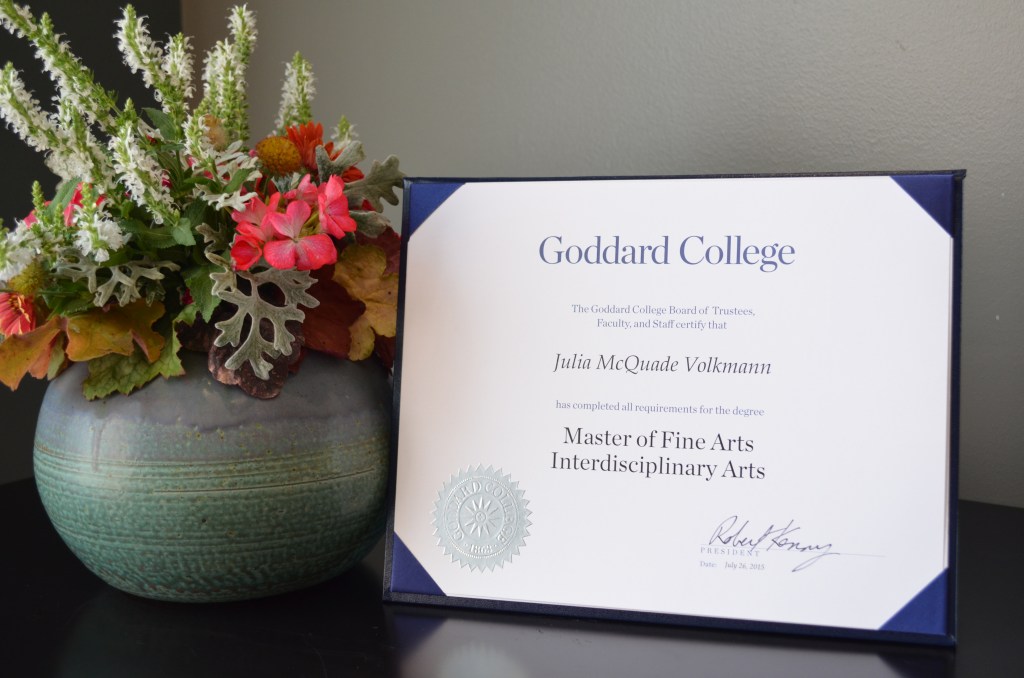
On Sunday, July 26th I participated in Goddard College’s commencement exercises on the beautiful Plainfield, Vermont campus. In my mind’s eye I see in vibrant technicolor the beautiful souls shining through the faces of the faculty, fellow graduates, other students in the program and the alumni present, physically and in spirit via Facebook posts. The final graduation requirement, fulfilled that weekend, was a presentation to the college community, giving an overview of the research and artistic work over the course of my studies. I attempted to provide a thumbnail sketch of my portfolio, using this website as my visual and sonic tool for introducing small bits of the work produced.
The cover of my 173 page portfolio document along with its title, (I’ve nicknamed it my magnificent obsession) is shown here.
In the portfolio’s introduction I included the following parable as metaphor for my spiritual and creative pilgrimage of discovery and becoming as an interdisciplinary and transdisciplinary artist within my studies at Goddard College. This is excerpted from Sacred Rituals, Connecting with Spirit through Labyrinths, Sand Paintings & Other Traditional Arts(Fair Winds, Gloucester MA, 2004) co-authored by Eileen London and Belinda Recio.
“A poverty-stricken rabbi from Cracow had a recurring dream about a treasure buried near abridge in Prague. Because his dream was persistent, he was compelled to travel in search of the treasure.When he arrived at the bridge, he discovered that it was heavily guarded, but having traveled so far, therabbi lingered in the area waiting for his chance to search for the treasure. After several days, a guardapproached him and demanded to know the nature of his business. Discouraged, the rabbi reluctantlyrevealed his dream and that he was there to search for the treasure. The guard admonished him, but then toldhim that he, too, had a recurring dream of a treasure, only in his dream, the treasure was buried under thehearth at the house of a poor rabbi in Cracow. The guard assured the rabbi, however, that he wasn’t foolishenough to go hunting for a treasure just because it appeared in a dream. Upon hearing the guard’s tale, therabbi became exuberant, hurried home, and sure enough, under his hearth, he discovered an immensetreasure.”(175)
Authors London and Recio state “The message of this parable reminds us that the sacred we seek is alreadywithin our hearts, but sometimes, in order to recognize it, we need to travel away from the familiar. This is theessence of pilgrimage—an inner restlessness that calls us away from home, to search for what the heart holdssacred. …Real or metaphoric, a pilgrimage (historically) had, and still has, the purpose of finding somethingthat holds profound significance to the traveler, culminating in a deepened spiritual state or personal transformation.” (176)
In the weeks ahead, I will include excerpts from my portfolio to illustrate waypoints of my own creative and spiritual pilgrimage throughout my studies in Goddard’s MFA program in Interdisciplinary Arts.
Thank you, Goddard.
FOOTNOTES
London, Eileen, and Belinda Recio. “Seeking What the Heart Holds Sacred.” Sacred Rituals: Connecting with Spirit through Labyrinths, Sand Paintings & Other Traditional Arts. Gloucester, MA: Fair Winds, 2004. 175-85. Print.
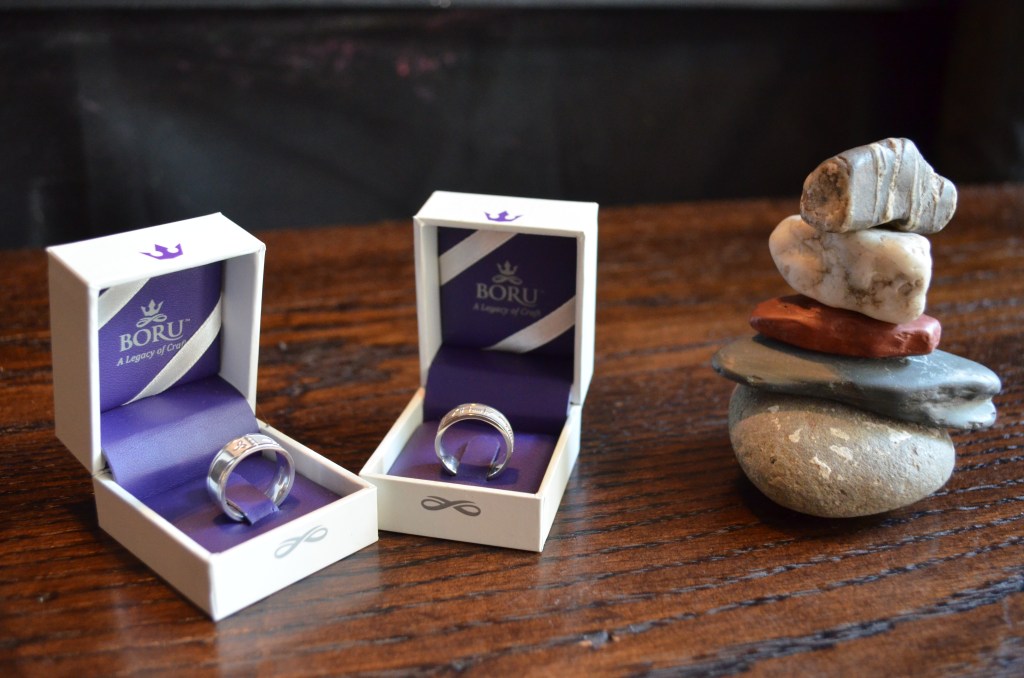
This post reflects upon my experiences as a witness this past weekend at the wedding of my daughter Anna to her life partner, and now wife, Bridget. The officiant at the ceremony was my daughter, Kara, Anna’s elder sister. Also present and participating was my daughter Eva, as well as Anna’s father, John Volkmann and his wife Kathy, Bridget’s father Jack O’Shea and her brother Brian. A few representative members of quite large extended families on both sides were present as well as a circle of friends and co-workers that have gathered round Anna and Bridget throughout their lives. All told, perhaps 50 souls bore witness and celebrated this beautiful marriage of these two mature, wise, joyous, accomplished, talented and dedicated women who model all that love is asking of us: A willingness to be open and touched by the love of another; a willingness to offer the kind of love that can transform everyone and everything it touches, beginning with the lover; a willingness to invite and welcome the support of a community in this most powerful of commitments. Volo Restaurant on Roscoe Ave. in Chicago was the perfect setting for this unique and moving ceremony.
Anna and Bridget devised, with Shay’s willing and open-hearted participation, a variation on the Celtic HandFasting ritual. In their ceremony, they dedicated themselves to forming a family of love, dedication, patience, forgiveness, and joyous celebration of each other’s unique gifts, held fast in the warm embrace of family. And so the binding of all six hands was made after the promises made by each member.
In these two photos, the WayMaking Cairn continues its role as my avatar, spiritual symbol of witness and giver of mute testimony. I offer the words of honor. The Cairn offers visual remembrance.
The couple is now on their honeymoon. After their return and the gifts are opened, there will be another post on the extended role of art in all aspects of this beautiful ceremony.
The rings, bearing Celtic symbols of love and promise.Anna’s graphic design of the words she and B agreed were their “keywords” to their lives together.
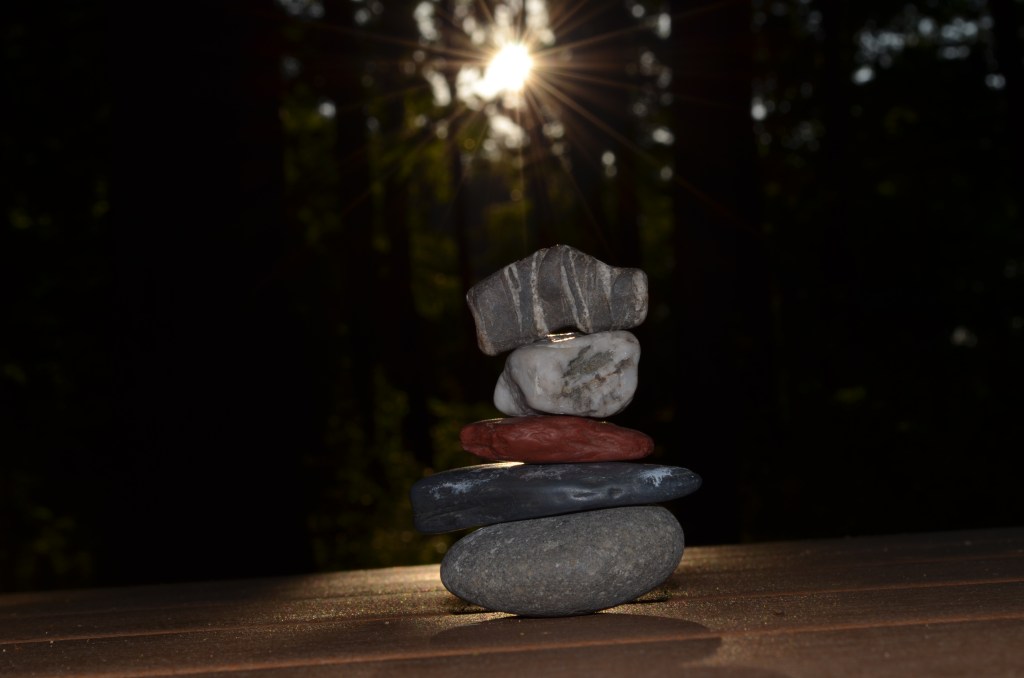
While driving to Vermont to attend commencement at Goddard College, I stopped at a rest stop along I 90. After driving most of the day, its no longer clear to me whether I was in eastern Ohio or had just crossed into New York. The late afternoon sun took my attention away from my road-weary body and I brought the Cairn to this site to bear witness to this ephemeral moment in time and space. Refreshed, I continued on my trip and arrived at Goddard the next day.
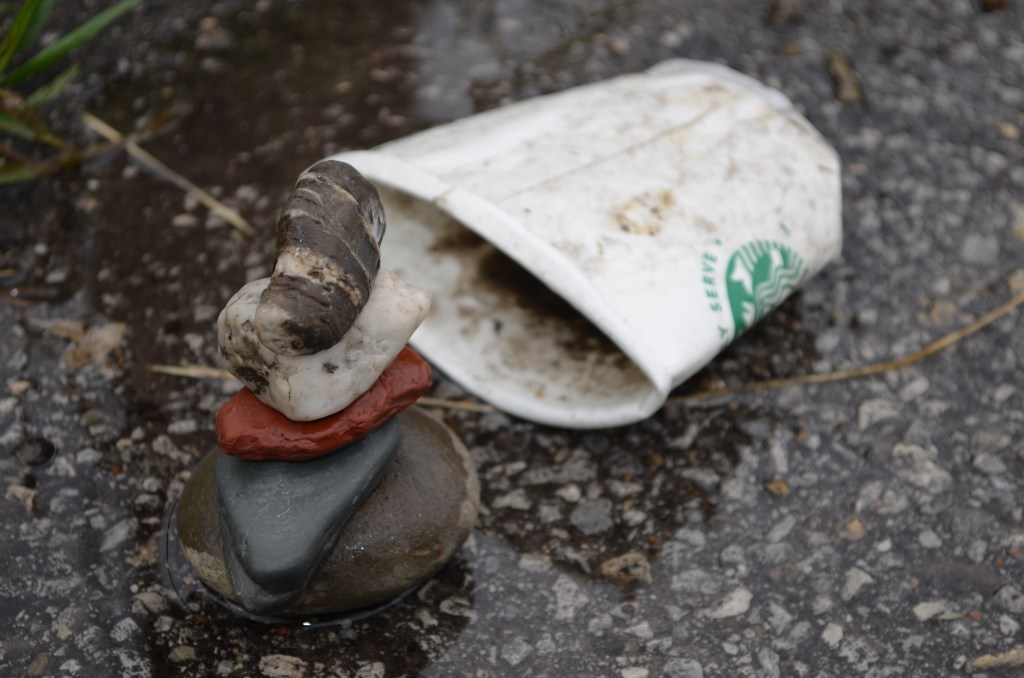
The WayMaking Cairn’s recent encounter with a discarded Starbuck’s coffee cup provides the grist for this post.
First, please recall where the name Starbuck originated. A quick search on Starbuck the character takes us to the Cliff Notes website. Remember Cliff Notes? The redemptive resource for all high school English class procrastinators as they cram the night before the exam? Cliff Notes has joined the ranks of every academic resource by establishing its own website presence. Click here to see its full character analysis for First Mate Starbuck in the classic Moby Dick, which I’ve redacted here for brevity’s sake.
“The first mate is the only man aboard the Pequod who resists Ahab’s plan to devote the ship’s mission to hunting and killing the White Whale. ….. But he lacks Ahab’s power. The chief mate argues that the ship’s mission, as prescribed by the owners, is to harvest as much whale oil as possible and return home safely, showing a profit. He feels it is “blasphemous” to be enraged by a dumb object of nature such as a whale, and he realizes that the lives of all aboard are at serious risk….. Ultimately, however, Starbuck acquiesces. He concedes that he is no match for the enormity of the charismatic captain’s spirit. Even though he is certain that Ahab is mad, Starbuck cannot take the action necessary to stop him. At any rate, the first mate obeys orders. As a character, he changes only because he submits to Ahab”
Parallels abound here as we consider the relative weights of the moral choice vs. the expedient choice made by both Starbucks. Consider these observations by Adam Minter in his April 2014 post Why Starbucks Won’t Recycle Your Cup on Bloomberg View. Minter reports that Starbucks produces over 4 billion disposable cups per year. Though the company announced in 2008 its goal of instituting recycling at all its company owned stores by 2015, it admitted in 2013 it had only achieved 39% compliance and doubted that it could ever achieve its goal of 100%. Why? Its not cost effective to recycle the cup fibers when the plastic inner coating also has to be dealt with. Unless the company produces much more paper waste to make the plastic removal process profitable, there is no motivation to recycle the cups.
Minter then opens the lens to consider our participation as consumers in perpetuating the use and discard of paper cups. “Composting keeps the cups out of landfills, but it generates greenhouse gases while destroying the recycling value packed into the cup’s fibers. Reusable cups are a nice idea, but one that consumers simply don’t embrace. In 2008, for example, the company set a goal of serving 25 percent of all beverages in personal, reusable tumblers by 2015; in 2011, it served just 1.9 percent in personal tumblers, and lowered the 2015 goal to 5 percent, despite making available low-cost tumblers (which have their own recycling issues).”
So, Starbucks, like its namesake in Moby Dick, cleaves to the highest totemic values of instant profitability (closing its eyes to the other costs to our world and our health in excessive greenhouse gasses) AND closes its eyes to the blasphemous nature of its own behavior. But, before we all jump on the bandwagon of finger pointing at the big corporations who make so much money in this array of unsustainable practices, let’s look in the mirror: we who consume Starbucks or any food item in a disposable cup or container, are also guilty of the same unethical and lazy behavior.
A few weeks ago I was coming home around midnight. As I drove down the alley toward my garage, I came upon four old tires lying in seemingly random locations across the alley right in front of my garage. I stopped the car, rolled each of the tires, one by one, to the side, safely out of traffic’s way on the grassy aisle between my fence and the alley’s asphalt surface.
How those tires could have come to be there in the first place is probably a never-to-be-solved mystery. Perhaps one of the many scrappers in the area lost them off the top of a too-full truck of found treasures? Was this a deliberate prank of some sort? A “gift” from someone who heard of the Waymaking Cairn’s ongoing contemplation of our daily trash?
Whatever brought the tires to my alley will probably never be known, but I was presented the next day after an afternoon rain with an opportunity for the WayMaking Cairn to contemplate these tires where they lay since the night before when I moved them out of the way.
The Rubber Manufacturers Association says this about rubber tires: “Properly handled, scrap tires do not present any major environmental problems.
If improperly handled however, scrap tires can be a threat to the environment. Tires exposed to the elements can hold water and be a breeding space for mosquitoes that carry disease. Tire piles can be set on fire through arson or accident. These fires are difficult to put out, and produce heavy smoke and toxic run off to waterways. Tire piles can also harbor other vermin, such as rats and snakes.”
My neighbor Bev, after suggesting I might make wall-mounted planters with the tire, then called the city to take the tires away.
Vermont is beautiful any time of the year. However, in the winter, there are occasions when the quality of the light on the night snow creates one breathtaking sculptural still life after another. I could do nothing else but respond to that which called me to be still, behold, and attempt to capture the ineffable quality of the evening scenes. Taken during this week’s residency on the campus of Goddard College.
IMBY – a play on the acronym NIMBY, which means “not in my backyard.” The phrase came to be associated with community activism that protests the location of a new element within the community which is perceived as a threat to the community. Sometimes the perceived threat is economic – property values might plummet. Sometimes the threat is environmental – the health of the community is at risk. In my case, I have been watching my neighbor’s fence slowly decay over the past several years, with many holes like this appearing as the long neglected wood crumbles under the elements of sun, wind, snow, rain and the encroaching morning glory vines and volunteer sumac trees.
With these images I attempt to let go of my negative thoughts about the ugliness of this fence, and instead notice how beautiful is the composition which the cairn’s presence permits me to see. I only need look through a lens that is free of judgement.
Yesterday my brother Mark suggested that the Waymaking Cairn make a trip to Cairn. Little did he know that trip had already taken place. The reunion with the long lost kindred cairn was memorable.
Today’s entry introduces the Waymaking Cairn, which has become a keystone of a new practice which I began before I knew that this would be a new practice. A practice that slowly reveals itself to me as I continue the work.
First, allow me to introduce you to the cairn, photographed where it first came into being; on a bed of rocks located on the campus of Rensselaer Polytechnic Institute in Troy, New York, July 2014. I was participating in a three day Listening Body workshop with about 11 other people, engaging in a variety of meditation exercises as facilitated by Heloise Gold. In retrospect, I believe the meditation opened up my consciousness, allowing me to deeply focus on the rocks on which we sat. As I sat cross-legged in the circle with the others, I began to select rocks within my reach one at a time, placing them around me, contemplating each one’s unique shape, color and striations, feeling the heft and particular outlines of each.
When we broke from the morning session I picked up the four rocks I had found particularly interesting and put them in my camera bag, intending to take them back to my room. My thought was to add them to a growing collection I had at home, which displayed stones from previous travels around the country. From across the circle David called to me, “Julie, let me give you a stone.” I was surprised when he began to search the stones at this feet, realizing that he had no stone ready to give me. Rather, he was looking for the stone that he wanted me to have, allowing his intuition to guide him, in response to his observation of my careful contemplation of the stones during our circle time. He handed me an oblong stone, its base color a deep grey, with irregularly placed white stripes circling the stone, zebra-like. I was touched by this simple gesture and fascinated by this oddly shaped rock that reminded me of a crooked finger, reminiscent of the fifth finger on my right hand, which has a permanently swollen and crooked knuckle from a long ago injury.
At this point, the stones had not yet been assembled into the cairn. This happened at the next circle time when we were sitting on the same bed of rocks and I saw Jane, sitting across from me, assembling a cairn. Later, she would tell me that she had been inspired to make a cairn after watching Jesus make a cairn. Jesus was to my immediate left in the circle and so the cairn which he made was out of my sight lines as he was stacking his stones on his left side. At our next break I retrieved my stones from the camera bag and I began experimenting with my five stones looking to see if they might be stackable. I quickly discerned that there was only one way that the stones could be stacked and that it would always be a precarious balancing feat. This truth would be the first of many metaphorical understandings of how my existence and the cairn’s existence were intertwined.
The Waymaking Cairn comes into sharper focus as I begin to discern how this is a conjoined art practice and meditative practice.
Thus was the cairn born; from an series of simple, unremarkable events that combined to bring about a greater focus and appreciation, a sense of awe and blessing, and a call to continue the journey of discovery in this new art practice. Without any recollection of how or at what moment I was inspired to do so — was it that same day or the next? — the idea came to me to photograph this small cairn in relationship to its surroundings. The travels of the Waymaking Cairn began; first around the RPI campus, then into the college town of Troy, and onward to the many places we have visited since then.
I have been fascinated by cairns for quite some time. Coming upon cairns at random places in my travels, I would wonder about who made the cairn. When did s/he make it? What was his or her reason for making that cairn at that time and place? After that fleeting sense of connection to the mysterious maker of the cairn in some previous time, I would let go of that train of thought and simply focus on the cairn itself, feeling its call: be here, now; be still, breathe; attend to this moment of time and focus on being in this place and only this place. Interesting to note is that I have long understood my photography practice to be a meditation, a manifestation of the call to attend to the moment in time and place. But I had never before felt the need to create a cairn and leave it in any particular place. Now I employ the cairn to attest to the meditative act, acting as a visible partner while serving as iconic subject, as a witness in each photographic image. It has taken on the status of my token item. Hmmm, could this be a new variation on the role of participant observer? I think so!
When I realized what a strong hold this new practice had upon me, I began researching cairns appearance in various cultures and geographies through the ages, in the hopes of using the information to better explain to myself and others what this new practice was about and why it was important.
Cairns were often used to mark a place of significance for the person(s) who created the cairn. Though the Waymaking Cairn is no more than 6 inches tall, some cairns are huge, weighing many tons and would have required numerous people and machinery to put these boulders and stone piles into place. Whatever the size, the cairn as marker seems (to me at least) to be there to alert others to the place as well. Sometimes cairns serve as geographical markers at key crossroads. Other times historians conjecture that they mark the place where something significant took place. Maybe it was a birth, a death, a wedding, a peace treaty, a ceremonial marker…. the possibilities are as infinite as are human activities. What all cairns seem to have in common through the ages is that they mark as special a time, a place, an event, a person or persons, a relational event, for example.
I experimented with a few names for this cairn and this project. I considered calling them listening stones, acknowledging their origin during the Deep Listening conference. But a cairn is more than the individual stones, it becomes a new entity and now when I see the individual stones, they feel incomplete to me – their true identity is the particularly ordered stack that you now see. Because this cairn bears witness to a location and moment of attention then moves on, the name WayMaking Cairn seemed best. Only after naming it did I come across another, similar term: ‘waymarking cairn.’ I still prefer the distinction offered in WayMaking because it emphasizes for me the sense of life journey. What I understand and elaborate upon in this practice, which is an awakened life journey, is the act of being fully present to the world in which we live. I do this by paying special attention to the mundane, often overlooked places and times, as well as those things that more easily can evoke fascination and wonder. I don’t have to know why places, people, objects and events call me to photographically mark that place in my journey, I need only be grateful for the breath of life and the glorious senses that allow me to see, hear, wonder, bless and even giggle sometimes in the moment of feeling alive and connected to the world around me in these precious moments of encounter.
I will be regularly posting photos of this participant observer WayMaking Cairn bearing witness to the mundane, the extraordinary, the overlooked, the sublime, the ordinary, the unremarked and miraculous in our travels. We chronicle the sacred act of attention and connection to life. Oh, yes, and the lovely, regular encounters with whimsy!