January 4, 2019
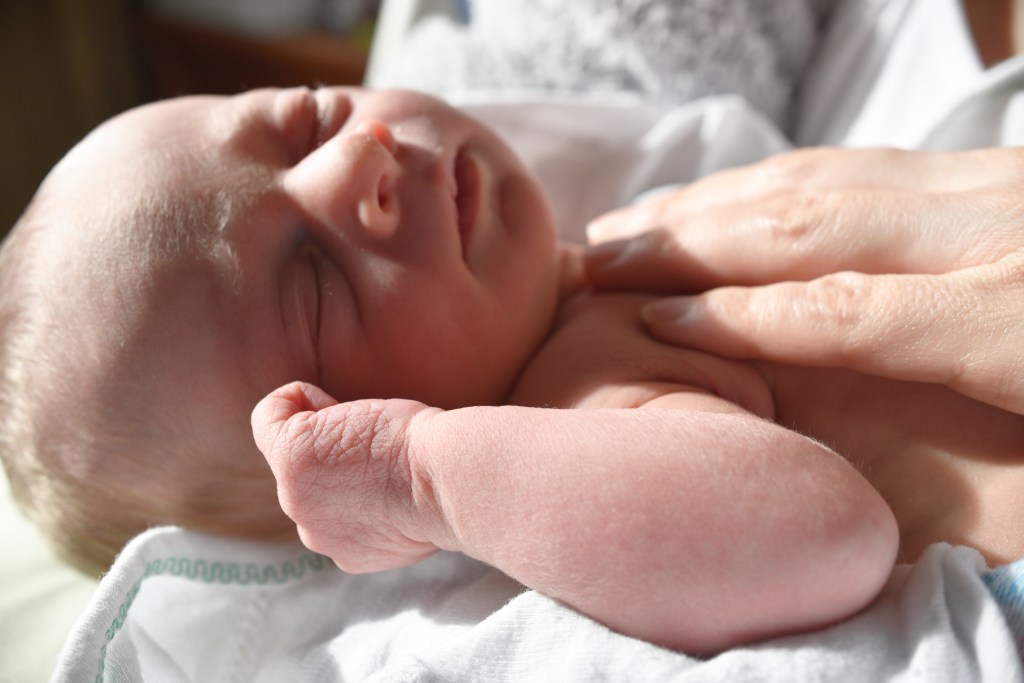
Mackenzie Rey Navarro Volkmann was born in Manhattan, New York.
The second born of Kara Volkmann, my daughter, and her spouse, Mike Navarro. The sister of Adrian Michael Navarro Volkmann. My granddaughter.
Beautiful soul.


January 4, 2019
Mackenzie Rey Navarro Volkmann was born in Manhattan, New York.
The second born of Kara Volkmann, my daughter, and her spouse, Mike Navarro. The sister of Adrian Michael Navarro Volkmann. My granddaughter.
Beautiful soul.


ANSWER: In the case of the women celebrated here, their names have become synonymous with the impact they’ve had on my life and the course of world events. Their individual life experiences in a myriad of modes and disciplines brought them to use their voices, their minds, their work, their creativity, their hearts and bodies to express themselves, thereby making the world a better place. There are millions of women who have had a transformative effect on the world in ways large, small and every point on the spectrum between. However, this homage is necessarily limited to 50 women I personally thank for their impact on me. I am better, stronger, wiser, more compassionate, and more capable because of their contributions.
The word search puzzle containing the names of the 50 celebrated women is embedded in the right panel of the entitled diptych that is currently on exhibit at the Austin Irving Library through March 2025. The postcards hanging from the tree branch in the left panel are individual notes to each woman whose contributions made a lasting impression on me and the ways in which I live and contribute my voice and work in the world.
I invite you to consider the women who’ve made a difference in your life and send them a postcard – whether they are in the after life or still walking this world.
If you’d like to be part of a living digital version of the work on this website, you may take a photo of the message section of your postcard and attach as an email to me at Julia.M.Volkmann@gmail.com. In that email, if you wish, you can include the name of the woman to whom your postcard is addressed and I’ll include that in the digital version as well.
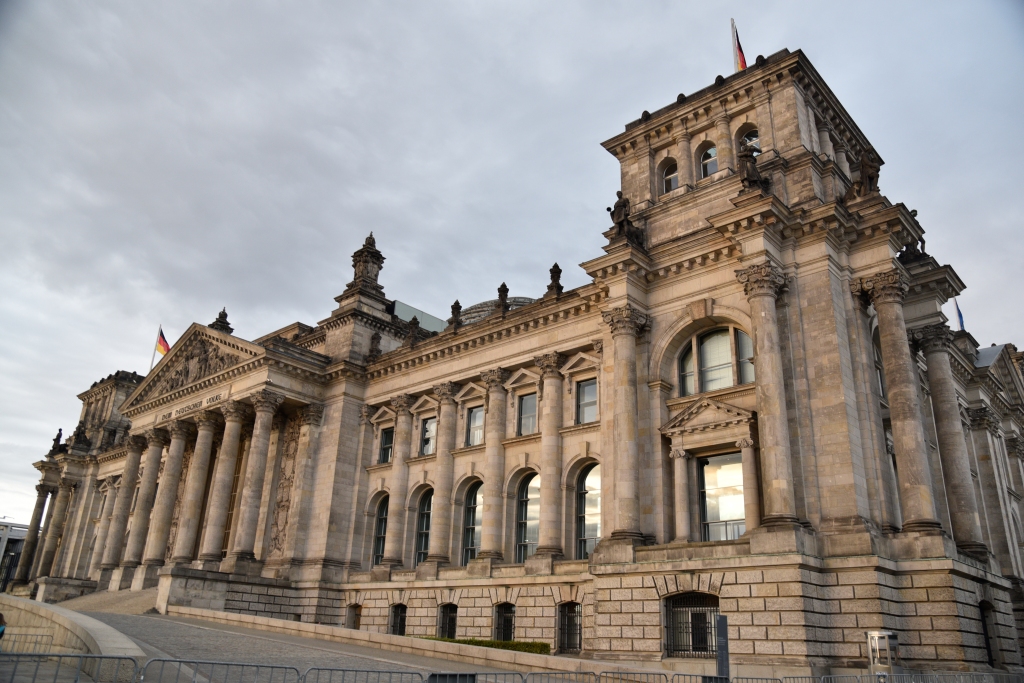
Hedwig Dances curated this trip in collaboration with UK based Tailored Travel. Twelve intrepid travelers, led by the incomparable guide, Thomas Abbot, would explore Germany Sept 5 – 13. We began with three nights in Berlin, followed by three nights in Weimar and then we capped our adventure with two nights in Dessau where our final evening would include the unforgettable performance of FUTURA, Hedwig Dances’ Bauhuas-inspired contemporary dance, at the Bauhaus 100 Festival on the historical stage in the original Bauhaus building on which Oskar Schlemmer was staging his works a century ago. This album represents photos from our first evening in Berlin when we went to the historic Reichstag to see the incredible futuristic dome atop the parliament building as designed by William Foster of Foster and Partners. All photos in this album by Julie Volkmann. To learn more about the project’s design and manufacture, check out this site:https://www.fosterandpartners.com/…/reichstag-new-german-p…/


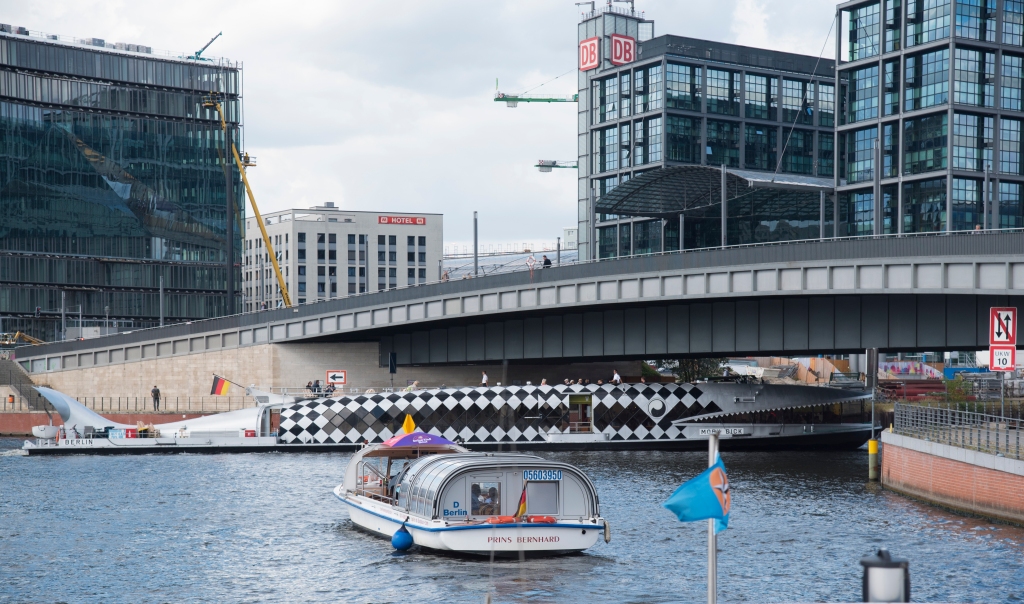
After the river boat excursion on the River Spree, we headed back to our hotel. As we drew near to the hotel, we came upon the Marienkirche, or St. Mary’s Church. The church’s website states “Presumably, the construction of the church as a parish church of the medieval New Town of Berlin was begun in 1270 . The first certain mention can be found in a letter of indulgence from 1294.”
I imagine that the three different exterior bricks are a testimony to the re-builds that happened during its history due to fire damage and then the upgrades that come about through time in response to stylistic preferences of each subsequent era.

The rough, hand-hewn quality of the exterior of the church did not prepare me for the elegance of the interior. Even with the scaffolding in place – old churches need lots of repairs – I was taken by the beauty and peace that pervaded the space.


Still jet lagged, but not wanting to miss precious opportunities to see Berlin, we set out on a walk to the river. After walking through an extended market along the curved street we looked down on last night, we finally hit on the river and walked in a westerly direction for about a mile before settling on a river cruise boat. Here a some shots from that lovely ride.

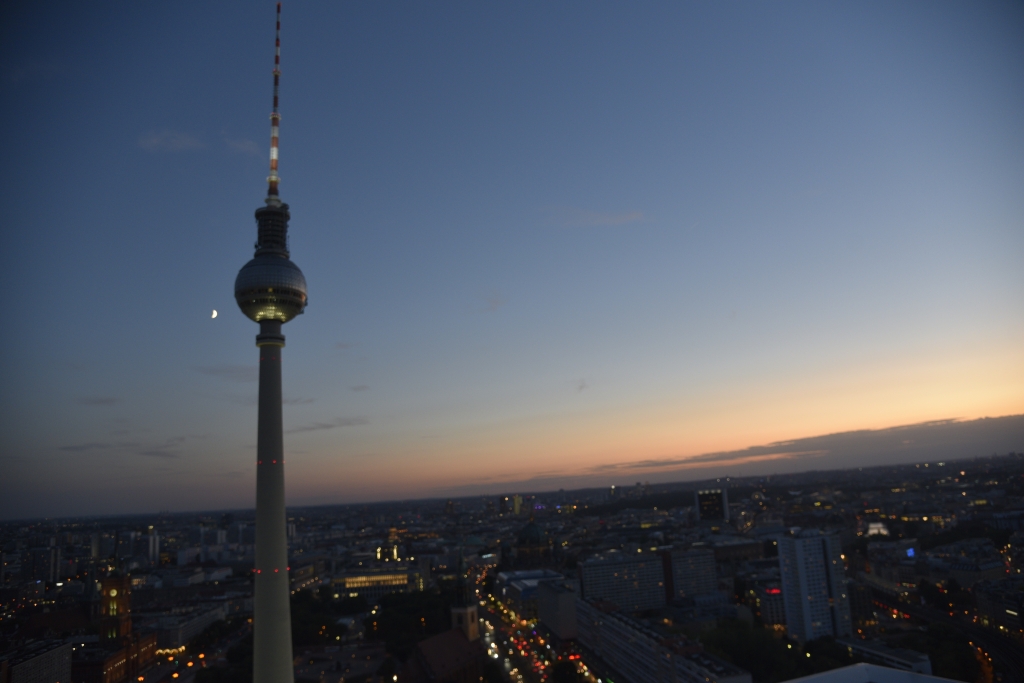
We arrived jet-lagged but juiced by the beautiful city of Berlin and the friendly welcome from all we met as we made our way across the city from TGL airport to our hotel the Park Inn Alexanderplatz. Here are a few photos from the roof-top observatory of the city

Welcome to the May 2019 calendar pages. This image was taken in Asheville, North Carolina a few years back when I began exploring a unique intentional community in that area. One of the properties that the community continues to consider how to rejuvenate includes a farm tract, trailer residences, and a large area where, in years past, folks have dumped old cars, thresher wheels, furniture, motorcycles, concrete mixers and more. A couple of tradesman had set up shop there too. In the midst of this polyglot of sights and possibilities was this very old, partially overgrown outhouse, and these whimsically placed chairs in a row on one side. I immediately imagined the chairs being there for those waiting in line to use the facility, and “Queuing for the Loo” became this image’s title. I was especially pleased to find a font for the calendar page that somehow echoes the feel of the old outhouse and aging chairs with peeling paint. 
This experimental film might also be referred to as a contemplative film. And it could just as easily be called a chance composition. My friend and fellow Goddard alum, Brenda Bowyer, conceived of a chance methodology for the creation of new art work, using special dice such as those used in Dungeons and Dragons. She asked me if I would like to play the chance game and I didn’t miss a beat in my “hell, yes!”
On March 3, I was given six weeks to make a work based on my unique results coming from the tossing of six dice. It will not surprise anyone who knows me that it took me eight weeks to complete the project. I stewed over possible ideas for seven and a half weeks and then had my aha moment this past weekend. All footage was gathered on Saturday and I finished the editing of the film, complete with credits this evening.
The film is 22 minutes long. I decided I didn’t want the criteria to create expectations in the viewer’s mind – I really wanted the viewer to have a “pure” experience of the film, so I wait until the end of the film to share with you the six elements that guided the creation of this work.
I will tell you one thing, though: I did a lot of research on non-narrative film for this project. what I learned became a primary driver for me in the creation of this work.
I welcome your feedback. Here is the link to RAIN
This image for the April page of my calendar was taken on the Campus of Goddard College in Plainfield Vermont on July 23, 2016. I had driven up through Michigan into Canada, stopping by to see fellow Goddard alum Annis Karpenko in Mississauga Canada. I continued driving a little further east before turning south to head toward Goddard for the commencement ceremony that included my friend Brenda Bowyer Farmwald. To make the event even sweeter, several of the Goddard alum from recent years were gathering at a beautiful farm house outside of town for several days. We intended to consider the ways that we might continue the meaningful activities of our joint studies while working toward our Interdisciplinary Arts MFA’s. We agreed that our group “hangs” on Google and the sharing of work and ideas while working in our diverse locations throughout the US, Canada and Europe was a rich and meaningful activity that we wanted to continue.
I saw this wire sculpture every residency. I presume (or heard?) that it was created by another alum of some years back. It had always interested me, but never more so than on this trip back to campus where I was keenly aware that I was no longer a student-insider, but someone slightly removed, off-center. I loved being back even as I mourned the loss of the focus and the rich interactions by and with faculty and fellow artists creating and implementing their study plans.
Having been raised in the Roman Catholic tradition, this tree form is richly symbolic for me. I was drawn to it, the smooth coiling wires of the trunk becoming gnarled branch and twig. In its bare form I perceived a living being manifesting a cycle of apparent deaths each winter and long-awaited resurrections each spring. No surprise that the power of this life-death symbology is leveraged in just about every spiritual and religious tradition throughout time.
Looking at the wire tree-figure that felt so alive to me, I experienced an ache, a yearning to be back again in the midst of the recurring cycle of our MFA residency. I wanted again to be immersed in each 15 week semester broken down into five three-week periods with “the packet” due at the end of each 3-week period. That had been my ruling cycle for 5 semesters. I still felt rootless without that cycle.
Rootless, like I felt leaving Columbia College after 12 years where our administrative lives were so closely tied to the academic calendar, with the grand climax each May with Manifest and three, then six graduation ceremonies over the course of two days – I helped plan them all. I attended them all.
Rootless, like I felt after 6 years at the Diocese of Gary in which the liturgical calendar rich with symbol and sacrament was the heartbeat of our work and prayer.
Rootless, like I felt when my marriage ended and I left the house in which the rhythms and schedules of kids’ lives, our work lives, our meal times, shower times, chore time and bed times were so inextricably woven for 22 years.
So many deaths and resurrections. Understanding the immanence here does not make easier the loss of each little world in which I have travelled for a while. Ironic, because I easily recall how I would chafe at the forms of each world with its cyclical demands, schedules and attendant frustrations. But once the form dissolved in the mist behind me as I walked away, how I missed those very things.
So. . . . the tree.
It still calls me to attention.


It’s been two months since I returned from my week in Cuba, traveling as part of the Hedwig Dances Touch Tour 2019 – the company’s fifth such curated immersion in the country’s art, dance, food, districts, monuments, history and more. There seems no simple way, no word or pithy phrase presents itself to me, to characterize my experience while there.
So, I begin with a few photographs from the first day and a few things my fellow travelers and I learned from our tour guide, Yunelbis. She would become a central figure during our week together, gently sharing information that enlarged our understanding even as she would offer us a different lens with which to view her country’s historical and political events, alongside Cuba’s vibrant arts culture, as well as the many dimensions of its current racial, agricultural, architectural and economic realities.


We noted that this location was well visited by many tour guides with their groups. We came to understand that the embargo has made tourism the most important means for Cuba to build its coffers, as long as the embargo prevents the export of any Cuban good to the USA.


On one side of Revolution Square was a large parking lot that was filled with the legendary Cuban taxis. These beautifully kept antique autos from the 50’s and 60’s were fascinating to behold. Yunelbis said that the many brilliant colors on the vehicles could be traced back to another reality of the strapped economy: Discontinued auto paints would be purchased in lots for reduced prices and then, once in the country, the word went out and the paints were snapped up by those wanting to spruce up their old automobiles. The embargo is the underlying cause that no new automobiles can come into the country – no one can afford them. The embargo makes everything that comes into the country very expensive because the ships that come in laden with goods must go out empty – hence the return trip is major lost revenue. To make up for the loss, the ships charge more to the importers, who make up that additional cost by charging more for the goods being shipped in.


The group had been traveling by shuttles, busses, and planes for the better part of two days to get to this point on Day One in Cuba. My roommate Marcia and I had caught the 7:30 am shuttle from our Miami hotel to get to the airport with enough time to go through customs and then catch our flight to Cuba with the rest of our group. After our extended walk-around of Revolution Square we re-boarded our bus, travelled across town, and then gratefully arrived at Melia Cohiba to check in, have a snack, accompanied by our first of many welcome Mojitos, refresh and then off to our first dinner in our first paladar.
“Paladares are a uniquely Cuban phenomenon,” said my tour packet. After the revolution and the mass exodus of so many people and the resultant economic crash, these private enterprises became an increasingly popular way for people to earn a few extra dollars by turning their homes into restaurants. We were also advised that all payments to the restaurants are in CUCs, (Cuban Units of Currency that are used exclusively by tourists to the country), which are then turned into the government along with earnings reports, from which the government takes a percentage and converts the CUCs into Cuban pesos, the local currency used by the citizenry. That evening, Atelier would offer us our first experience of this uniquely Cuban phenomenon.


At dinner that evening we each stood in turn to introduce ourselves to the others in the group. We were sixteen members in all; many from Chicago, one from Omaha, one from New York City, one from upstate New York, one from Washington DC, and one from California. We began to bond that night and through the rest of the trip we experienced an enriching sense of connection, delight in shared discoveries, and growing mutual appreciation. We arrived at Atelier when the light was still strong. When we left it was dark. After returning to our hotel, which overlooks the Malecon, a small group of us decided to brave the 4-lane highway to get to the ocean side.

Look for more entries in the upcoming days and weeks on my experiences on this trip. I hope to understand better as I share the images and write about the days, the people and the discoveries.
The image for March was taken in the Hartford Reservoir in Connecticut in February or March of 2002. Not too sure on the date at this point. I was visiting my daughter Kara, who lived on the 3rd floor of an old Victorian home in the historic district of Hartford. She was working at the Hartford Stage at the time. While Kara was working I went for a hike in the reservoir – the light was my favorite kind of light that comes in late winter with overcast skies and much moisture in the air. I came across an old stairwell that still stood, covered in moss, though whatever structure it once led to was long gone and no trace of a building foundation remained to tell its story.